
⭐ Introduction
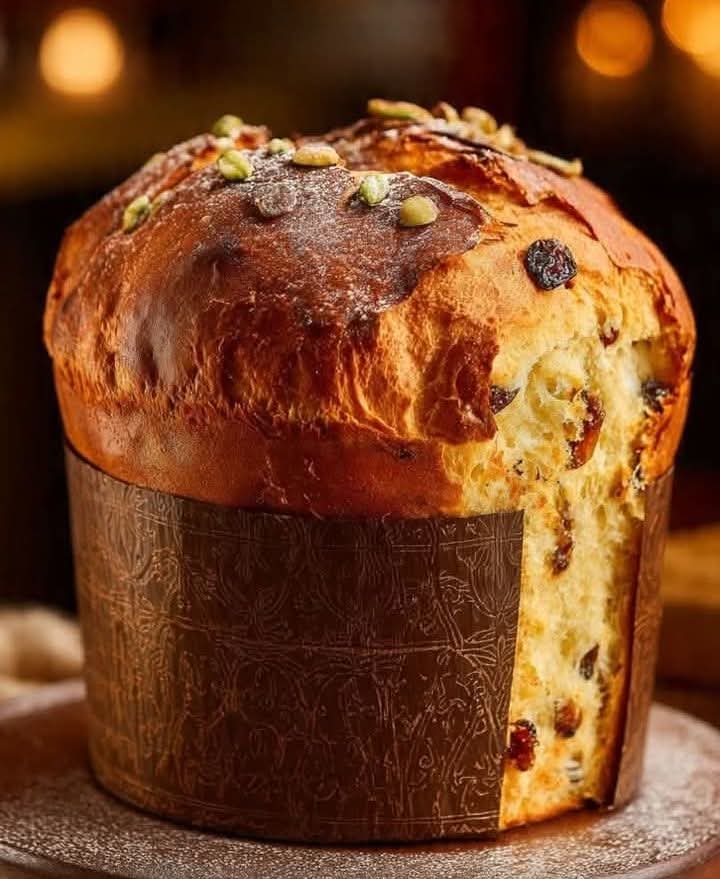
Panettone is an iconic Italian sweet bread enjoyed especially during Christmas. Its signature features—an airy, buttery crumb, delicate citrus aroma, and rich fruit pieces—are achieved through a slow fermentation process that develops incredible flavor. While it takes time and patience, the result is a beautifully domed, golden loaf worthy of any celebration.
📜 A Brief History
Panettone originates from Milan, Northern Italy. Legend says it was created by a young nobleman who disguised himself as a baker to win the heart of his beloved—he invented the luxurious bread filled with butter and fruits to impress her family. Others say it was an accidental creation by a kitchen assistant named “Toni,” whose mishap resulted in a “pane di Toni” (Tony’s bread).
Regardless of the legend, by the early 20th century, panettone became a mass-produced holiday tradition in Italy—and eventually, around the world.
🌿 Benefits of Panettone
Even though it’s a festive sweet bread, it does offer some benefits:
- Natural fermentation can improve digestibility.
- Dried fruits provide fiber, vitamins, and natural sweetness.
- Slow rising doughs often require less yeast, creating better flavor and texture.
- Homemade versions avoid preservatives and artificial flavorings.
📝 Ingredients (Traditional)
For the Pre-ferment (Biga or Sponge):
- 100 g bread flour
- 100 ml warm water
- 5 g dry yeast (or 15 g fresh yeast)
Main Dough:
- All the pre-ferment
- 400 g bread flour
- 120 g sugar
- 4 large egg yolks
- 2 whole eggs
- 120 g softened butter
- 5 g salt
- 1 tsp vanilla extract
- Zest of 1 orange
- Zest of 1 lemon
- 150 g raisins (soaked in warm water or rum)
- 100 g candied orange peel
- Optional: 1 tbsp honey (adds moisture and softness)
For Brushing:
- 1 egg yolk
- 1 tbsp milk
🥣 Instructions & Methods
Step 1 – Make the Pre-ferment
- Combine flour, warm water, and yeast in a bowl.
- Mix until a wet dough forms.
- Cover and let rise 2–3 hours, or until doubled and bubbly.
Purpose: Improves flavor and dough strength.
Step 2 – Prepare the Main Dough
- In a large bowl or mixer, combine:
- pre-ferment
- flour
- sugar
- egg yolks and whole eggs
- vanilla
- citrus zest
- salt
- Knead for 10–12 minutes (stand mixer recommended).
- When the dough becomes elastic, slowly incorporate the butter, 1 tablespoon at a time, until fully absorbed.
- Knead until the dough is silky, stretchy, and passes the “windowpane test.”
Step 3 – First Proof
- Place dough in a greased bowl.
- Cover and let rise 3–4 hours or until doubled.
Step 4 – Add Fruits
- Drain raisins and pat dry.
- Fold raisins and candied orange peel into the dough evenly.
- Knead gently until distributed.
Step 5 – Second Proof
- Shape dough into a smooth ball.
- Place into a panettone mold (1 kg size).
- Let rise another 3–4 hours, until the dough reaches near the top of the mold.
⭐ Formation (Shaping & Final Preparation)
- Once dough has risen, make a cross-shaped cut on top.
- Add a small piece of butter into the center of the cut.
- Brush lightly with egg wash (yolk + milk).
- For a more domed shape, some bakers let panettone rest uncovered for 15 minutes to dry slightly before baking.
🔥 Step 6 – Baking
- Preheat oven to 170°C (340°F).
- Bake for 40–50 minutes. If the top browns too quickly, cover with foil.
- Panettone is done when a skewer comes out clean.
❄️ Step 7 – Cooling (Very Important)
To avoid collapse, cool your panettone upside down:
- Insert two long skewers through the base.
- Hang upside down between two supports (chairs, pots, boxes).
- Cool completely for 6–8 hours.
This step preserves height and texture.
🍽️ Serving
Slice into vertical wedges. Serve with:
- espresso
- hot chocolate
- mascarpone cream
- sweet wine